
Current Temperature


 Log In
Poll
 Loading ...
Recent News →
- Attacks in Iran spike oil prices, higher gasoline prices coming
- Water security enhanced by improvements to reservoir infrastructure
- Farmland dominates as native grassland diminishes
- Golden Suns compete in playoffs
- Jets begin spring campaign
Recent Blog Posts →
Farmland dominates as native grassland diminishes
Posted on March 12, 2026 by Taber Times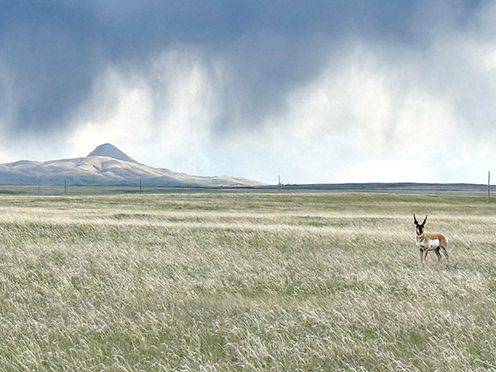 Times Photo Couretsy of MULTISAR.
By Cal Braid
Taber Times
Local Journalism Initiative Reporter
Industrial-scale agriculture in southern Alberta has tapped the land’s productive potential and continues to maximize the value of endless acres of prairie land. That land is the bread and butter of both the farmers who grow the crops and the many urbanites who have little connection to the land where their food comes from.
But long before the arable prairies were industrialized, the farmland was native grassland: a natural habitat for the plant and wildlife species that ‘grew up’ there. Now, that habitat has diminished to a near-breaking point.
Kristen Rumbolt Miller, a wildlife biologist with the Prairie Conservation Forum works with the province’s MULTISAR program – an acronym for multiple species at risk. Her perspective differs from that of farmers, agronomists, and ag scientists insofar as it looks at preserving the habitats and species that are native to the prairies. Miller’s work with MULTISAR primarily engages with cattle producers in an effort to manage range lands sustainably.
She discussed the impact of agriculture on wildlife in southern Alberta, noting that 75 per cent of Alberta’s species at risk inhabit grasslands – which have declined by 67 per cent since 1970. Key species affected include grassland birds, which have declined by 95 per cent.
“There’s been a huge, huge impact of primarily agriculture on wildlife,” Miller explained. “The reason being is because basically, we’ve lost about 75 per cent of our native grasslands in Alberta. Those are grasslands that have never been broken – turned into pasture or cultivated.”
“As we’re losing these native grasslands, we’re losing the species that rely on them. And we’re a prairie ecosystem, so most of our wildlife here in southern Alberta evolved under grazing pressure from bison and need those grassland habitats, but they’re simply just disappearing.”
In her estimation, native grasslands are extremely undervalued, “because, let’s face it, crops are worth more than cattle. Wind energy is worth more than cattle. Oil and gas, urbanization and things like that. It all has a higher value to society than the native grassland.”
MULTISAR’s job isn’t to battle the economic powers that be or to dispute how private land owners manage their cultivated lands, but rather to educate, inform and encourage responsible stewardship of grasslands by cattlemen and women.
Miller said bird species like the chestnut-collared longspur or thick-billed longspur have declined by 95 per cent and are one of the fastest declining groups of species on earth.
Alarmingly, temperate native grasslands like those in southern Alberta are now the most endangered ecosystem in the world. “A lot of people think it’s coral reefs or the rainforest,” she said. “But it’s our temperate grasslands in North America. They’re disappearing faster than the Amazon rainforest.”
To sum it up, “The biggest threat to grassland wildlife is basically the conversion of native grassland to primarily agriculture, but also, like I said, urbanization and industry. There’s basically just so many competing land uses here in southern Alberta.”
Whatever controversies have arisen over the negative impacts of cattle on the environment, Miller pointed out that “here in Alberta, the reason that we still have a native grassland is because there’s cattle on them.”
“If there wasn’t cattle grazing them, then they would be turned into crop land or used for industry or whatnot, and not to mention cattle also fill that role that bison vacated when they were extricated. So the grassland evolved under grazers. They need something to graze them to thrive and be productive.”
So can anything be done to reverse the disappearance of grasslands? Miller conducts rangeland assessments with MULTISAR as a free service which provides cattle producers with site-specific information. She uses the program’s website, social media, and presence at events to target kids when they are “more like sponges.”
“We also go to the Calgary Stampede every year, where we reach a lot of people. So we’re trying to educate people. The challenge is, how do you get urbanites to care about native grasslands?”
She said that people’s attitudes have warmed, and the trajectory of shared knowledge is moving the needle in the right direction, “but it’s still a lot of work to reach the right people.”
Miller welcomed all to check out the program’s website at multisar.ca. MULTISAR has social media pages with pictures and information on Facebook, Instagram and X.
Leave a Reply
You must be logged in to post a comment.